


One of the most confusing aspects of chronic back pain is this:“If the injury is gone… why does the pain remain?” Many people struggle for years with back pain that makes no mechanical sense. Scans show nothing new. Treatments fail. The body should be healed —but the pain continues.
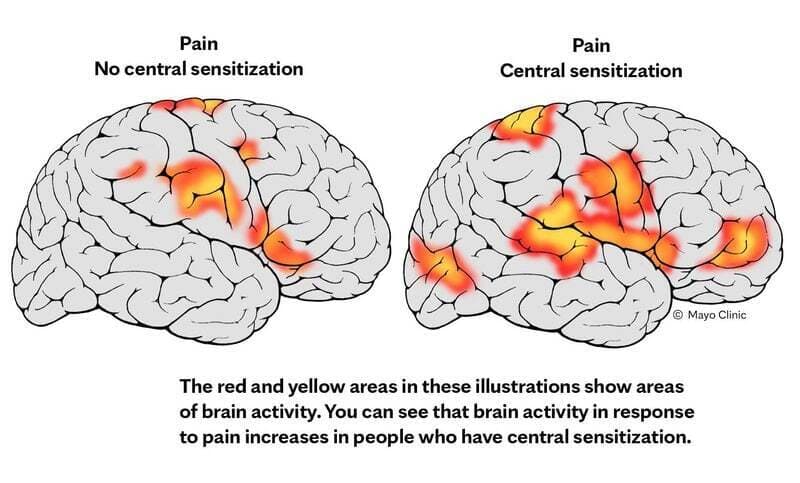
The Mayo Clinic has a name for this phenomenon:Central sensitization. And it may be the single most important (and overlooked) reason why your back still hurts.
What Is Central Sensitization?
According to The Mayo Clinic Guide to Pain Relief, central sensitization happens when the nervous system becomes overly reactive to pain signals—even long after the original injury has healed. Think of it like a car alarm stuck in the “on” position. Or a radio dial jammed on full volume. Your system starts overinterpreting normal or harmless signals as threats. “The brain and spinal cord can create symptoms by themselves,” Mayo researchers explain. “Even in the absence of new damage.”
It’s All About Neuroplasticity
Neuroplasticity means your brain can rewire itself in response to experience. That’s good news when you’re learning a skill. But not when your nervous system is learning to expect pain.
Here’s how the Mayo Clinic puts it:“As the brain becomes faster at processing pain signals, it can no longer accurately determine which inputs indicate danger. It begins to amplify pain even in response to minor or non-harmful sensations.”
This creates a vicious cycle:
- You hurt
- You fear the pain
- Your nervous system listens—and turns up the dial again
Real-World Examples
Central sensitization explains a host of strange pain patterns:
- Pain that flares after stress, not movement
- Pain that persists long after tissues have healed
- Phantom limb pain (where the limb is gone, but the pain remains)
- Sensitivity to light touch, sitting, or gentle movement
- Pain that bounces from place to place
It’s not “in your head,” it’s in your nervous system. And the good news is it can be reversed.
What /the Makepeace Method Adds
If your pain isn’t coming from tissue damage anymore, then the solution can’t be physical treatment alone. The Makepeace Method helps you recognize these patterns—and calm the alarm system that’s been stuck in the on position.
You don’t need to keep chasing structural solutions. You need to retrain your brain.
Sources:
https://connect.mayoclinic.org/blog/chronic-pain-symptoms-rehabilitation/newsfeed-post/hello/
Keep learning


Harvard Confirms Back Pain Is Usually Not Structural
Harvard researchers found that most spinal changes seen on MRI scans—disc bulges, degeneration —appear just as often in people without pain. These are normal signs of aging, not proof of damage. The true driver is often the brain’s over-protective alarm system.


Real people. Real relief.
These are real stories from people who were stuck in pain—until they tried the Makepeace Method. Now they're free.
Since doing the reset, my lower back and glute pain has never returned.


“Knowing what I know now, I regret having back surgery.”

“I feel so much better — and I’m grateful this exists.”

“This took my pain from a 9 or 10 down to a 1 or 2.”

“After doing the program, I got up from my desk one day and the pain and tingling were just gone.”

“I've had significant improvements in my pain levels. I now feel confident about managing my back health.”

“This method makes a complex idea easy to implement. Bottom line: I’m feeling much better.”

“I was bedridden for weeks. Now the pain is gone, and when it flares, I can shut it off.”

“I was a massage therapist for 30 years. Several weeks ago I started an excruciating ordeal with back pain. The Makepeace Method was life changing for me. My back has improved tremendously. Thank you a million times over.”

“I loved your course. It was a blessing listening to your videos. It has given me hope on my healing journey.”

“I had been truly suffering for months. Within a few days, I was moving freely again. Thank you.”


You've done your time in pain. Now take your life back.
You’ve fought hard and tried it all, but the burden was never yours to carry forever. Your brain is ready to reset, your body to feel safe again. Pain is not who you are - it’s time to reclaim your life.
